Tayrona Indigenous Confederation (CIT)
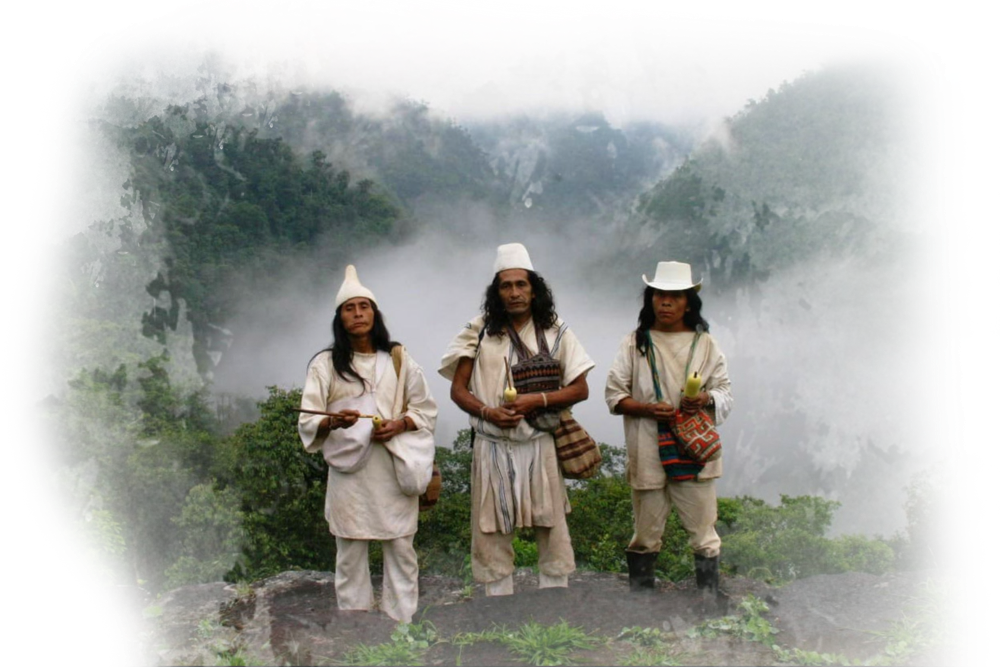
To exercise Government over the Ancestral Territory, the Mamus and Traditional Authorities of the Arhuaco People created in 1976 the Tayrona Indigenous Confederation (CIT), which is recognized as "the organizational and political structure that represents the Arhuaco People, this figure is led by the authorities in the head of the General Directive, therefore, all internal and external issues must be subject to the guidelines issued by the government itself, based on the Law of Origin." (pp. 15-16)
In 1976, Luis Napoleon Torres was elected, the year when the orientation of the Mamus created the Tayrona Indigenous Confederation (CIT), as the organization that politically represents the Arhuaco people. On the basis of the Mamus, it was determined that this organization would be chaired by the Governor of the Arhuaco People and would have the mission to defend the Ancestral Territory and the Iku culture. It should be noted that the CIT is a political organization that is created to represent the Territory and the Arhuaco People collectively, and by the date of its creation there were no Resguardos in the Sierra Nevada of Santa Marta, which means that the figures of the Territory, of Cabildo Governor of the Arhuaco People and of the Tayrona Indigenous Confederation are first in the time that the Resguardos.
Document Guide to the relationship of the Arhuaco people: Traditional and Cultural Foundation of the Arhuaco people (General Policy). General standards and criteria of the Arhuaco people. (2014).
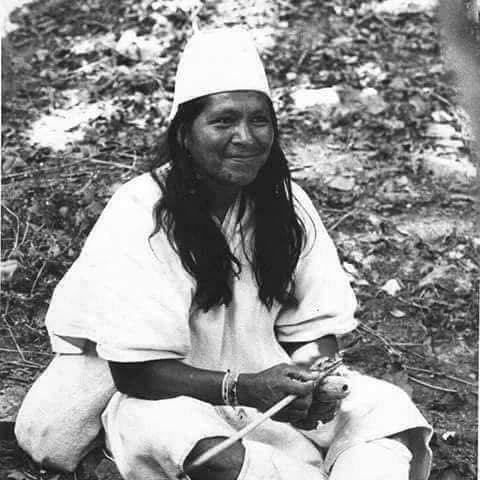
Luis Napoleon Torres- Bunkwanawingumu
The being Iku (Arhuaco) is based on the fulfillment of the Law of Origin, the being Iku is based on those norms that are in each of the elements of our Territory, the being Iku is to comply with those norms that are not written, which are not norms that were made yesterday, but millennial norms that have been made since the creation of the World for us. That is why they are ancestral laws that cannot be changed, that the human being cannot change from one moment to another and as the Arhuaco People we are in the duty to fulfil what was left to us from the beginning. That is why when the Arhuaco People make decisions it does so from that basis, from the fulfillment of the Law of Origin by the guidance of our Mamus or our Zaku or Spiritual Mother (...) And the mission of us as Arhuaco People is to ensure compliance with that Law of Origin so that there is a balance between the material and spiritual world, the Mamus are to guarantee that balance not to cause an imbalance. That is the task we have, to take care of the spirit of every element that exists on the territory: of water, of stones, of the earth. (...) The younger brother must understand that and guarantee it to us so that this orientation is not lost, so that we continue to live in time as a people, with a culture, with a government of our own, that is our mission.
Mamu Seyarin Left
The Organization of the Arhuaco Indigenous People
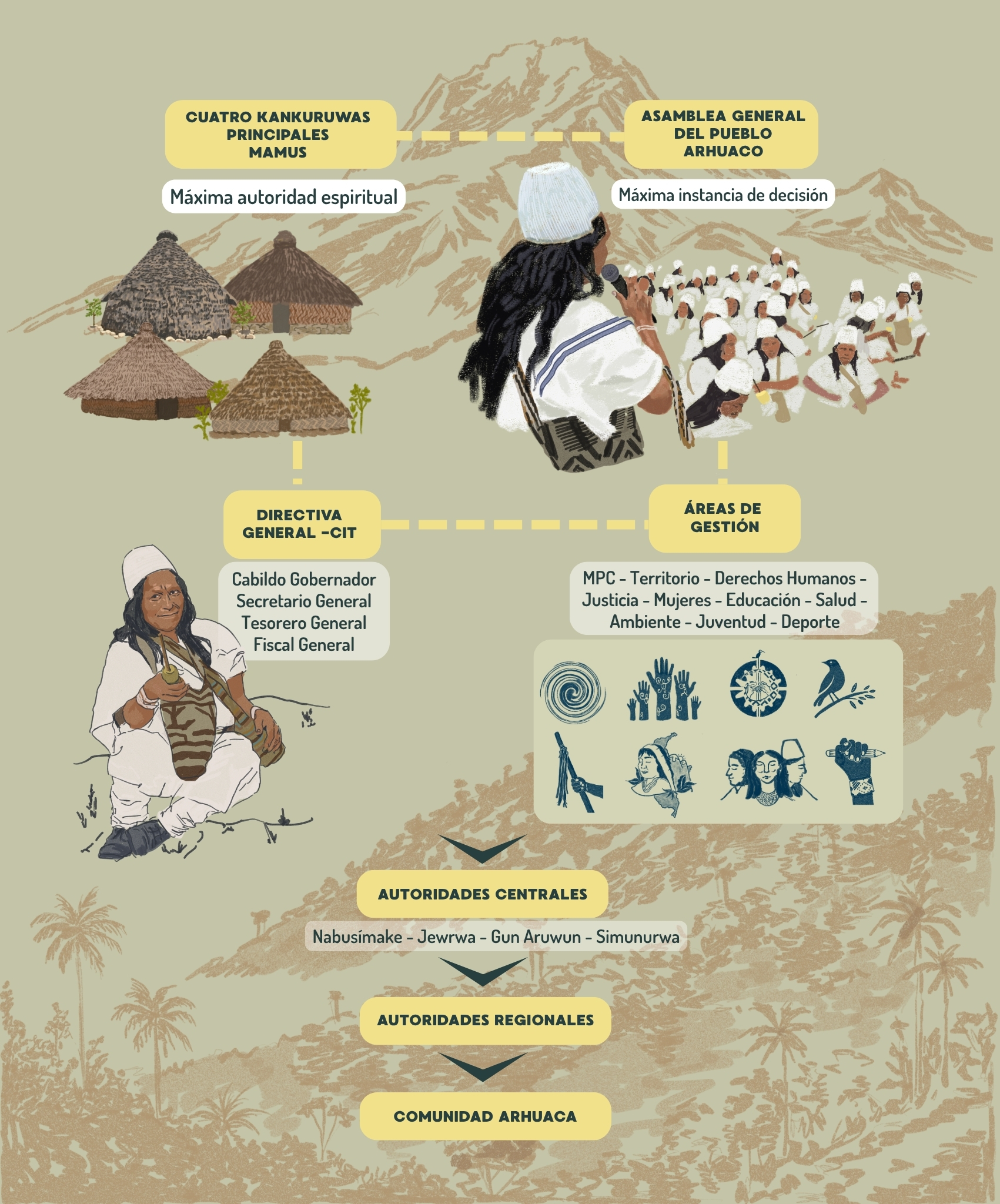
"Our Law of Origin emits a traditional order of government represented in Zaku Jin- Kaku Jina Murunsama, Ka'dukwu, Kunkurwa, this form of government interpreted by the Mamus, who based on cultural principles and foundations, guide, advise and give the relevant recommendations for its implementation and development by the political and administrative body representing the Arhuaco people.
This body includes:
The General Assembly, General Directive, Authorities of each Centre, Regional Authorities and Major Authorities. "
Document Guide to People's Relationship Arhuaco: Traditional and Cultural Foundation of the People Arhuaco (General Policy). General People's Rules and Criteria Arhuaco. (2014).
In the Arhuaco People there are sixty (60) communities, settled between the departments of Cesar, Magdalena and La Guajira.
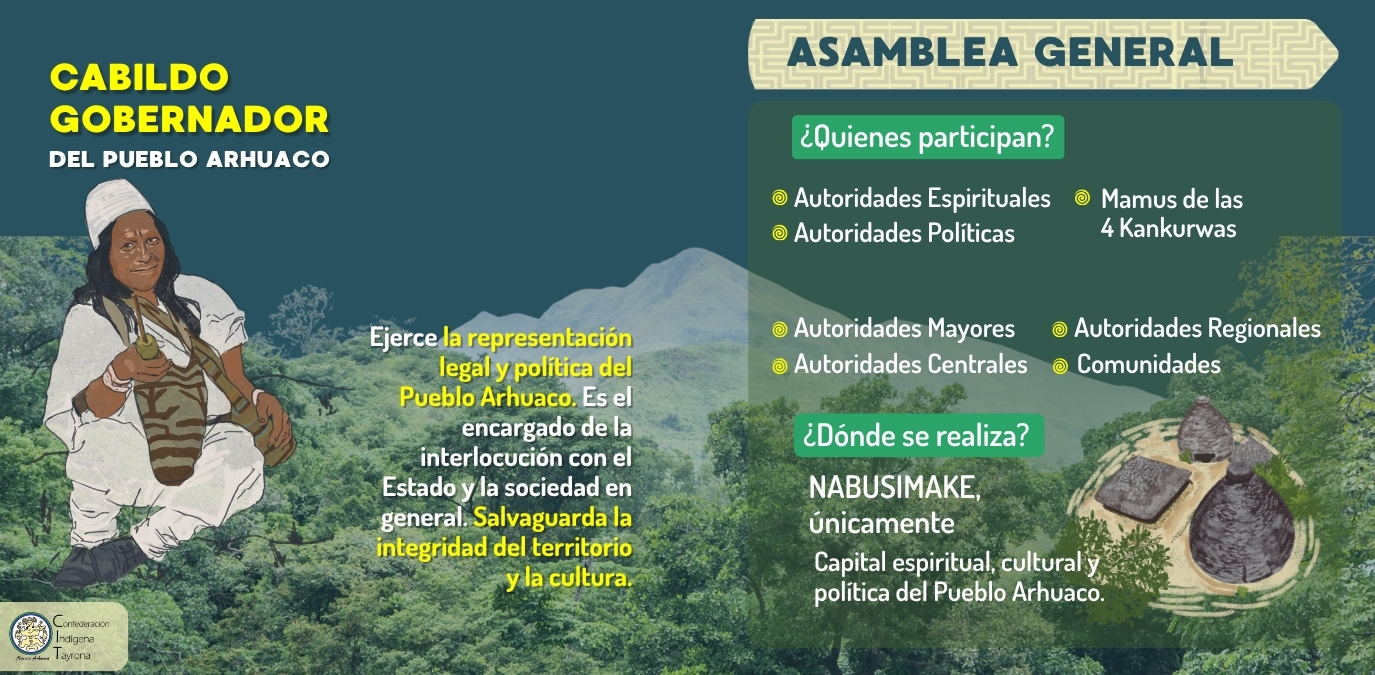
The General Assembly "It is the body of political and administrative government, which analyses the issues of general interest that concern the Arhuaco people, therefore their character is participatory. It is empowered to define the actions to be implemented by the General Directive and the internal government in general. It is a body of consultation and evaluation for decision-making in a unified and agreed manner; where the Mamus, regional authorities, major authorities, delegates and staff are convened with specific activities within the community. In addition, corrective measures and measures are taken to maintain order and balance within the territory; that is, where self-government is strengthened, policies are defined and guidelines given by the Mamus are socialized."
"The General Directive, is responsible for leading the internal processes, strengthening the system of government itself, and promoting the exercise of governance and authority, maintaining the unity of its people and strengthening of autonomy, it is therefore incumbent upon it to promote the unity of the Mamu and the authorities, to coordinate the traditional decisions given from the four Kankurwa of the Arhuaco people and to ensure the functioning of the Tani [...] [and] must govern the ancestral territory, to meet the requirements on issues that the community suggests and to develop actions consistent with the social, economic and political reality in order to preserve the cultural identity of the Arhuaco people. "(p. 19)
The General Directive of the Arhuaco People is composed of: the Governor, who is the legal representative; the Secretary General; the Treasurer General; the Prosecutor General. "(p. 18).
The total population of the Arhuaco people is estimated at 36,642
Decisions in the Arhuaco People
- "In the General Assembly subjects of a strictly general nature of collective interest, which concern the Arhuaco people, will be dealt with and it is the space for assessing, making political and administrative control. "
- "It is the competence of the General Directive to guide, plan, define, monitor and evaluate the policies of territory, self-government, own economy, justice, education, health, the allocation and distribution of resources, the evaluation of projects and in general all issues concerning the Arhuaco people. "
The Ancestral Territory of the villages of the Sierra Nevada of Santa Marta
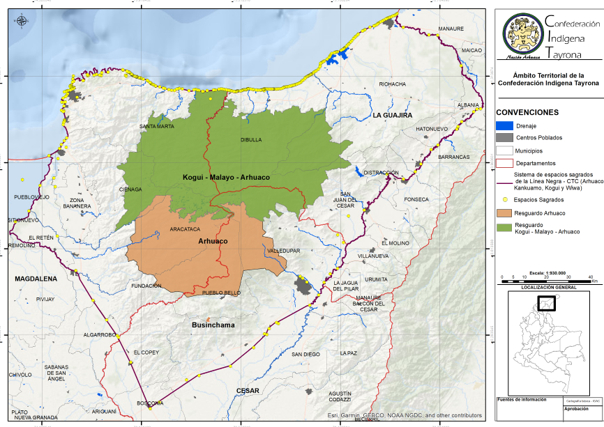
The Territory is one and is the Ancestral and Traditional House of Indigenous Peoples Arhuaco, Kogi, Wiwa and Kankuamo. Each of the indigenous peoples of the Sierra Nevada de Santa Marta has a representative organization, for institutional relationship and for exercising public authority to the Colombian State and Western societies in general. These are: Tayrona Indigenous Confederation (CIT) (Arhuaco people), the Organization Gonawindúa Tayrona (OGT) (The Kogi people), the Organization Wiwa Yugumaiun Bunkuanarra Tayrona (OWYBT) and Indigenous Organization Kankuama (OIK) (Kankuamo people). The political unity of the four peoples takes place in the space of El Cabildos Territorial Council (CTC)to direct everything related to the management and management of the Ancestral Territory.
The ancestral knowledge of the peoples of the Sierra Nevada de Santa Marta is a National Heritage Site and was also inscribed on the List of the Inmaterial Cultural Heritage of the Humanity of Unesco. Our ancestral territory was the first to be recognized at the national level since 1973 by Resolution 02 "by which the Black Line or Theological Zone of the communities of the Sierra Nevada of Santa Marta is demarcated," in 1974 the Sierra Nevada of Santa Marta was declared an Indigenous Reserve and later issued Resolution 837 of 1995 "by which article 1 was amended. From Resolution 02 of 1973," and more recently, Decree 1500 of 2018 was issued "By which the ancestral territory of the peoples Arhuaco, Kogi, Wiwa and Kankuamo of the Sierra Nevada of Santa Marta is redefined, expressed in the system of sacred spaces of the" Black Line, "as a traditional area of special protection, spiritual, cultural and environmental value, in accordance with the principles and foundations of the Law of Origin, and Law 21 of 1991, and other provisions are adopted."
The Black Line is a territory in which the rights of the peoples Arhuaco, Kogi, Wiwa and Kankuamo, on the one hand, are shared, expressed in the figure of the Kogi-Malayo-Arhuaco, Arhuaco of the Sierra Nevada, Businchama and Kankuamo.
The Kogi-Malayo-Arhuaco Rescue corresponds to 407,000 ha, the Arhuaco Rescue of the Sierra Nevada 206.166 ha, the Businchama Rescue 128 ha and the Kankuamo Rescue 25,516 ha, for a total of 639,597.22 ha corresponding to areas of the Rescue.
The Ancestral Territory of the Black Line is located in the north-eastern part of the country with an area of 1,843,720 hectares and is located in 18 municipalities in the departments of Magdalena, Cesar and La Guajira. This territory comprises 348 sacred sites within a biotic and cultural ecosystem of great importance as it has a wide wealth of flora, fauna, heritage, social and cultural.
The Sierra Nevada of Santa Marta is the highest coastal mountain system in the world, its variety of ecosystems and endemic species of flora and fauna make it one of the most biodiverse places in the country and the world, for this reason it has different environmental protection figures such as UNESCO Biosphere Reserve, Forest Reserve Area Law 2 of 1959 and Sierra Nevada National Natural Park of Santa Marta to preserve its natural wealth.
This ecoterritorial complex includes the entire altitudinal gradient from sea level to the highest heights of the Sierra (5775 m). The peak chains with permanent snow, are oriented on a axis with a west-east direction; above 3000 m are located numerous lakes of glacial origin, in which the rivers are formed that descend on its three large slopes. Because of its geographical, climatic and geomorphological characteristics, the region is a complex mosaic, which includes almost all the life areas of the Geotropic, from spiny half-desert bushes, mangroves, dry tropical forests and humid tropical forests, mountain and moist forests, to perpetual snow.
The wide range of ecosystems found in SNSM can be grouped into nine life zones or biomas: equatorial moist, tropical alternohygric, tropical subxeroptic, tropical desert, subandine forest, Andean jungle, moor, supermoor and level.
This pyramid-shaped mountain system extends between the departments of Magdalena, Cesar and la Guajira: from its three sides, to the west is the Ariguaní, to the south-west runs the Cesar and to the east the Ranchería.
The geographical isolation has allowed the development of a high level of endemism in areas of life above 800 m. Some 3,000 species of plants are believed to exist in the Sierra Nevada. The high level of endemism, reaching about 5% of existing species of flora and fauna, especially above 1 000 mn. It is known that 16 of the about 600 species of birds registered in the Sierra are endemic; 12 of the 46 species of amphibians and reptiles are endemic and in these you can find a degree of endemism of 100% above the 3 000 m. In addition, the Sierra and its surroundings are important habitats for about 90 species of migratory birds from the northern hemisphere.