
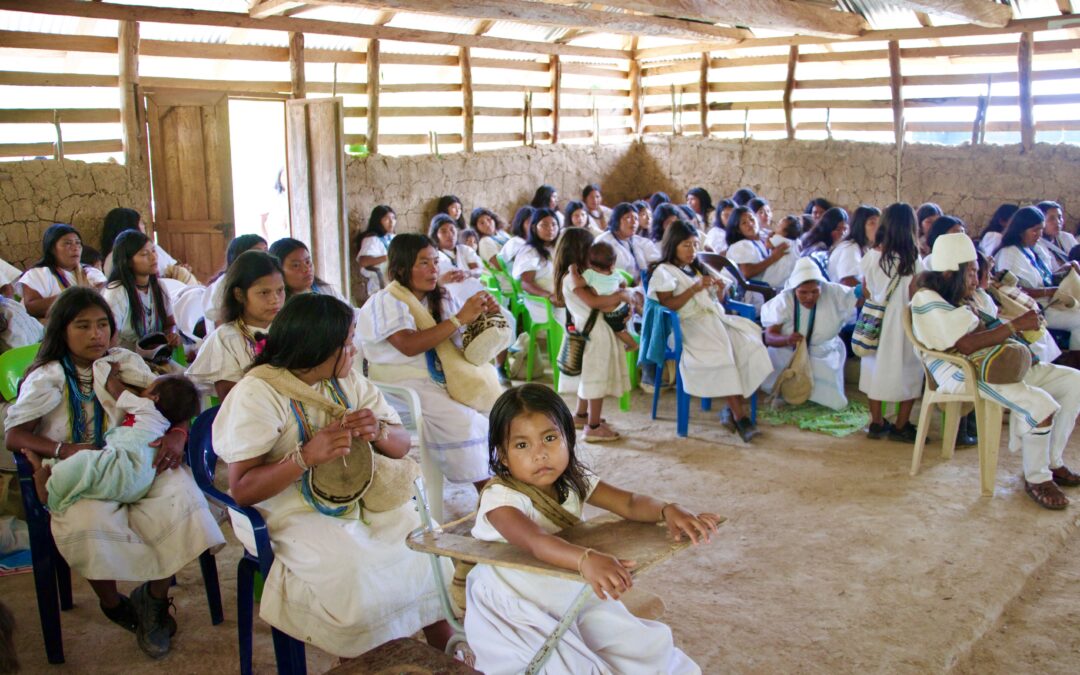
From the Tayrona Indigenous Confederation (CIT), we advanced in the community of Isrwa, territory of the Arhuaco Indigenous People in the Heart of the World, with the territorial deployment phase of the prior consultation on Environmental Services Payments (PSA) and REDD + (Reduction of greenhouse gas emissions from deforestation and forest degradation, as well as conservation, increased carbon stocks and sustainable forest management), held on 25 and 26 April.
This meeting space brought together the Indigenous Authorities and communities of the eastern Sierra Nevada area of Gonawindúa. Within the framework of the fundamental right to prior consultation, this socialization was attended by the Ministry of Environment and Sustainable Development and the Life Fund, who presented the initiatives of the administrative measures and policy instruments associated with these mechanisms.
From the word, the thought and orientation of our Indigenous Authorities, we consolidate this meeting as a space for decision on the importance of the territory, reaffirming that any measure that affects it must be built from the principles of autonomy, self-knowledge as an original people and balance with life.
During the days, in conjunction with the Traditional Authorities and the technical team of the CIT, we collected a series of reflections on the regulation and administration of the economies of the Zaku, noting that it is not possible to insist on external models that fragment the understanding of the territory and put the conservation at the service of the logic of the market. In this regard, we reaffirm that the discussion cannot be limited to the economic value of incentives, but focus on whether these mechanisms recognize self-government, the economies of indigenous peoples and respect for our forms of life.
We also express our concern about the conditions under which these mechanisms are implemented, particularly when they respond to other models that generate dependence, deepen inequalities and alter the meaning and guidelines for the care of the Zaku.
From the Law of Origin and the cosmovence of the Arhuaco Indigenous People, we understand the territory not as a material good, but as an integrality guided by our knowledge systems, the life plans and the spiritual relationships that sustain our survival and permanence. In this regard, we raise the need to move towards a model that recognizes and pays for territorial care in a comprehensive manner, incorporating ancestral practices such as orchard, food systems, animal care, cultural and spiritual use of the territory, respect for sacred spaces and the transmission of knowledge.
We also insist on the construction of their own legal instruments that respond to this orientation, proposing the development of a decree that guarantees the full recognition of our rights and safeguards for the four peoples that live in the Sierra Nevada of Gonawindúa: Kogi, Arhuaco, Wiwa and Kankuamo.
We also warn about the economic, cultural and spiritual risks associated with these mechanisms. We note that conservation cannot be disconnected from the mandates of the Law of Origin or dependent on external compensation, as this could affect our territorial autonomy, transform our own economies and disharmonize the care of the territory and the Zaku.
In this first territorial meeting, we reaffirm the importance of the fundamental right to prior consultation as a legitimate space for the indigenous peoples, from our own autonomy and self-government, to define the path of decisions that affect our territories. We also stress the need to recognize our own systems for territorial care, which have historically sustained balance and life in the Heart of the World.

